By Neil Griffiths Bsc (Hons).,MChemA.,CChem.,CSci.,FRSC.,FIFST.,FSOFHT
Director for Neil Griffiths Advisory Ltd
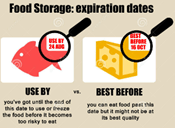
The need to legally indicate ‘use by’ or minimum durability dates on prepacked foods has a long history dating back over 50 years in Europe. The legal requirements of when to use a ‘use by’ date rather than a minimum durability date (‘best before’ or ‘best before end’) have not significantly changed over that time and it is therefore interesting that there is currently renewed debate on which products need a ‘use by’ declaration rather than a minimum durability. This has led to a considerable number of products being relabelled with a minimum durability rather than a ‘use by’.
There is no doubt that the current considerable pressure being placed on the food industry by government, consumer bodies, charities and media in the need to reduce food waste is the principal reason for this amount of relabelling. This is even though many of the products that now carry minimum durability dates rather than ‘use by dates’ have previously for many years if not decades been labelled with a ‘use by’ date.
A ‘use by’ date is currently legally required to be given in the case of foods which, from ‘a microbiological point of view, are highly perishable and are therefore likely after a short period to constitute an immediate danger to human health’. Anyone who sells a product beyond its ‘use by’ date is guilty of a criminal offence as the product is defined legally as unsafe at this point. Consistent with many legal definitions the meaning of the words it contains have been open to much debate and interpretation over the years. In particular the meaning of ‘highly perishable’ and ‘after a short period’ when applied to a particular food product.
Whilst it is inevitable that lack of clarity on the meaning of such terms has and does lead to different interpretations of when a ‘use by’ should be given these have mostly been resolved over the years through government and industry guidelines and common practice. This is not to say that there have been many occasions over the years where I (and I am sure many other food professionals) have found examples of food products labelled with ‘use by’ were the need for its use is not immediately obvious. As such I am supportive of continual review of the need for ‘use by’ labelling (as opposed to minimum durability labelling) obviously set against the legal definition requiring its use.
I know there have been many food professionals, including myself, that have expressed concern that pressure being placed to reduce ‘use by’ labelling on food labels, on the altar of reducing food waste, could have a deleterious effect on food safety as a result. I therefore have the following observations which I hope will be helpful for all those food professionals tasked with deciding whether a ‘use by’ label can be replaced with a minimum durability.
As a precedent has already been set in declaring a ‘use by’ has:
- previous food professionals got this wrong based on the legal definition for the declaration of ‘use by’ and can this be clearly justified as such?
- there been a change to the manufacturing process or storage of the product which no longer renders it highly perishable and likely after a short period to constitute an immediate danger to human health?
- new testing been undertaken which demonstrates that a ‘use by’ declaration is not necessary, and can it be defended as to why this testing hadn’t been undertaken originally?
- a precautionary principal been applied to your decision process? In other words, if in doubt take the safe approach.
The answer to these questions will decide whether your company can defend itself against any incident/challenge that may occur because of this labelling change. Of one thing I am certain, the need to reduce food waste would play no part in deciding whether your company had labelled the product correctly.
 Neil Griffiths Publications Limited